

Key Takeaways
- You can’t deploy AI safely without data governance. Tools like Microsoft 365 Copilot read from SharePoint, OneDrive, Teams, and email using existing permissions. If access is wrong, AI will expose it.
- Shadow AI is already a security risk. Many employees are using public AI tools today, often pasting sensitive business data into systems you cannot audit or control.
- Microsoft 365 Copilot requires preparation. Copilot readiness means auditing file permissions, enforcing least-privilege access, and cleaning up legacy sharing before rollout.
- Private AI tools can reduce risk for light users. A secure, private AI chat solution can give staff a safe alternative while you prepare for deeper Copilot integration.
AI is here, and for UK IT Directors, it’s all getting very messy. For most organisations, this question now shows up as: how do we get ready for Microsoft 365 Copilot without exposing sensitive data?
While keynote speakers at tech conferences love to talk about a utopian future where AI writes our code and cures diseases, the reality on the ground is far more chaotic. In 2026, the primary challenge isn’t adoption (which is fast-becoming vital), but control.
Recent research suggests that over 70% of UK employees are already using unapproved consumer AI tools at work, a phenomenon known as shadow AI. Your staff aren’t waiting for a board-approved strategy; they’re pasting sensitive client emails into public chatbots today to save time.
This leaves businesses stuck between a rock and a hard place. You know you need to provide a sanctioned AI tool to stop the data leaks, but the gold standard, Microsoft 365 Copilot, comes with a price tag and complexity that can terrify a Finance Director.
So, how do you balance innovation with control? Do you go all-in on Microsoft’s ecosystem, or is there a case for a lighter, private AI alternative? This article strips away the hype to compare your options, the costs, and the critical AI data governance work required for both.
Need to Organise A Strategic IT Project?
Don’t let AI adoption happen by accident. We help you build a formal roadmap that balances innovation with security, ensuring your investment delivers real ROI.
Artificial Intelligence Security Risks and the Shadow AI Problem
Before we compare the solutions, we need to define the threat. The reason shadow AI is so dangerous is not that the tools are malicious, but that they’re hungry.
When an employee takes a confidential merger strategy document and asks a free, public chatbot to “summarise this for me,” that data often leaves your corporate boundary. By default, many public tools either retain or process inputs in ways you cannot audit. In some cases, many public Large Language Models (LLMs) treat user inputs as training data.

That means your proprietary secrets could effectively be digested to make the model smarter for everyone else, including your competitors.
The specific artificial intelligence security risks in this scenario are twofold:
- Data Leakage: Once sensitive text is pasted into a public web session, you have lost custody of it. It creates a copy of your data on infrastructure you do not own and cannot audit. UK regulators have warned that when organisations submit personal or confidential data to generative AI tools, they may lose control over how data is stored, processed, or reused, making regulatory compliance difficult to demonstrate.
- Regulatory Failure: If that pasted document contained Personally Identifiable Information (PII), you have likely breached GDPR. You cannot exercise a Right to be Forgotten on a neural network that has already learned from your data.
To stop this, you need to give your staff a safe lane, a tool that gives them the productivity boost they crave, but guarantees that your data stays yours.
Related Reading: Top 10 Cyber Security Training Tips to Protect Your Business from Attacks
The Prerequisite and Why You Can’t Just ‘Switch On’ AI
If you’re considering deploying AI, you might assume the biggest challenge is training your staff to use it. It isn’t. The biggest challenge is the mess currently hiding in your file estate.
This is the heart of AI data governance.
For years, many organisations have relied on security by obscurity. Sensitive folders lived in SharePoint sites nobody visited. Confidential files sat in OneDrive locations that were technically accessible but practically undiscovered. Teams channels accumulated documents with inherited permissions that were never reviewed.
That model collapses the moment you introduce AI.
Tools like Microsoft 365 Copilot don’t guess what users should see. They surface everything a user account is allowed to see across SharePoint, OneDrive, Outlook, and Teams. If a document was accidentally shared five years ago, AI will find it instantly.
Say a junior employee asks Copilot: “Show me last year’s salary review data.”
If that spreadsheet exists in a SharePoint library with overly broad permissions, the AI will retrieve it without hesitation.
This is why governance is a prerequisite, not a follow-up task.
Before deploying any enterprise AI, organisations must complete a permissions hygiene audit. That means reviewing who can access what, where sensitive data lives, and whether historic access decisions still make sense. AI does not necessarily create new security problems, but it does expose the ones you already have.
For most organisations, this starts with an AI readiness assessment focused on permissions, identity, and data exposure.
Data Governance Audits
Copilot respects your permissions, even the bad ones. Before you deploy AI, let our team scan your SharePoint and Teams environment to identify and fix over-exposed sensitive data.
Solution A: The Gold Standard of Microsoft 365 Copilot
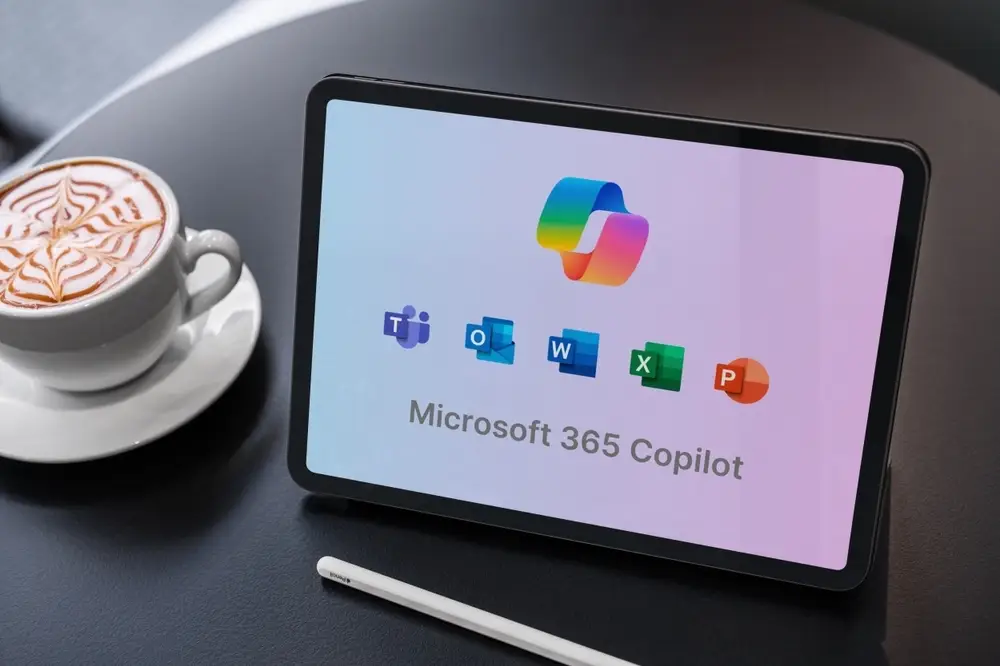
For organisations deeply embedded in the Microsoft ecosystem, Microsoft 365 Copilot is the ultimate productivity tool. It’s a sophisticated tool that sits inside Word, Excel, Teams, and PowerPoint.
The killer feature of Copilot is the Microsoft Graph. Unlike a generic chatbot that knows nothing about you, Copilot has real-time access to your emails, your calendar, and your documents. You can say, “Draft a proposal based on the emails from Sarah last week and the pricing spreadsheet on SharePoint,” and it will understand the context, find the files, and write the document.
However, this power comes with two significant barriers:
- The Cost: At roughly £16-£25 per user per month, it is a significant line item. For a 50-person company, that is a huge annual commitment.
- The Complexity: Because it has such deep access to your data, Microsoft 365 Copilot readiness is a major project. You cannot roll this out without strict governance, or you risk the oversharing nightmare described above.
For power users, like executives, content creators, and coders, the ROI is undeniable. But for the average staff member who just needs to draft the occasional email or summarise a PDF, the cost can be hard to justify.
Related Reading: Is Microsoft 365 Copilot Worth It for SMEs in 2026? Costs, Risks, and ROI
Solution B: The Agile Alternative of On-Demand Private AI
For many businesses, buying a Copilot license for every single employee is overkill. Does your warehouse manager really need AI integration in PowerPoint? Probably not. But do they need a secure way to draft an email or summarise a report? Absolutely.
This is where a private ChatGPT for business solution fits in.
Nexus offers an alternative approach we call WorkplaceGPT. Think of this as a safe lane for your staff. It provides the same chat interface and intelligence you’re used to from public tools, but it runs inside a secure, private environment (typically hosted on Azure OpenAI).
- The Privacy Guarantee: Unlike the free version of ChatGPT, the data you type into a private AI gateway is not used to train the model. It’s a closed loop. Your company secrets stay yours.
- The Cost Control: Instead of a flat yearly fee per user, these tools typically operate on a consumption model (pay-for-what-you-use). For staff who only use AI once or twice a week, this can significantly reduce costs compared to full Copilot licensing for light users.
It doesn’t replace Copilot because it doesn’t have deep integration into Word or Excel, but it solves the shadow AI problem instantly without breaking the bank.
Enterprise AI Services
Beyond chatbots, AI can revolutionise your workflows. Whether you need a private, secure gateway, custom development, or strategic advice, our team builds solutions that fit your business model, not just Microsoft’s.
Which Tool Fits Your Strategy?
In 2026, the question is not “Should we use AI?” but “Which AI do we need?” Most mature organisations will likely end up with a hybrid mix of both.
The table below summarises where each option fits best.
|
Feature |
Microsoft 365 Copilot |
Private AI Gateway |
|
Best For |
Power users, Executives, Content Creators |
General staff, Ad-hoc tasks, Light users |
|
Integration |
Deep (Word, Excel, Teams, Outlook) |
Light (Chat interface only) |
|
Data Access |
Full Access (Reads your emails and files) |
Limited Access (Only what you paste in) |
|
Cost Model |
Fixed Annual Licence (Per User) |
Flexible/Pay-as-you-use |
|
Governance Need |
Critical (High risk of internal oversharing) |
Moderate (External leakage protection) |
Related Reading: Why External Penetration Testing Matters More than Ever in 2026
Start with Safety, Not Software
Whether you choose the deep integration of Copilot or the agile flexibility of a secure AI chat, the first step is identical: you must secure your foundation.
Adding high-speed AI to a low-governance network is a recipe for disaster. Before you buy a single license or issue a single token, you need to understand where your sensitive data lives and who has access to it.
Don’t let the fear of cost paralyse your innovation. Start small, start secure, and ensure your roadmap covers both technology and policy.
Next Step: Free IT and Security Audit
You cannot build a skyscraper on shaky foundations. Our IT audit validates your current security posture and data governance, providing the factual baseline you need to deploy Copilot or Private AI safely, all at no cost to you.
Article Sources
- Society for Computers and Law. AI Data Leaks & Shadow AI: The Legal Minefield Facing UK Organisations in 2025. June 18th, 2025
- Microsoft Learn. Overview of Microsoft Graph. Accessed February 9th, 2026
- Microsoft UK Stories. Rise in ‘Shadow AI’ tools raising security concerns for UK organisations. October 13th, 2025
- Microsoft Learn. Data, Privacy, and Security for Microsoft 365 Copilot. Accessed February 9th, 2026.
- National Cyber Security Centre (NCSC). Guidelines for secure AI system development. Accessed February 9th, 2026.